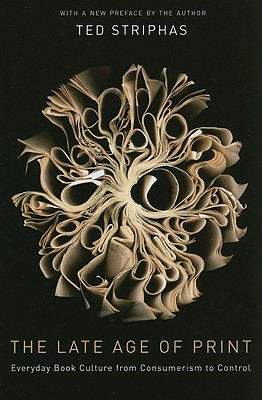
Great news! A good Samaritan, whose handle is “creiercret,” recently uploaded the free, Creative Commons-licensed PDF of The Late Age of Print onto the document sharing site, Scribd. Here’s the link to the PDF if you’re interested in checking it out. The book has already had more than 100 views on the site, I’m pleased to report.
Late Age has been accessible for free online for almost a year, so why am I so excited to see it appear now on Scribd? Mainly because the site just added new sharing features, making it easy to send content to iPhones, Nooks, Kindles, and just about every other major e-reader you can imagine. In other words, The Late Age of Print’s mobility-quotient just increased significantly.
I mayhave some more exciting, mobility-related news about the book, which hopefully I’ll be able to share with you in the next week or so. I’ll keep you posted. Until then, be sure to check out The Late Age of Print on Scribd, and why don’t you go ahead shoot a copy off to your favorite e-reader while you’re at it!?
On February 10, 2010, a German court began what may well be the start of the book industry equivalent of the dismantling of Napster.
Earlier that month, six global publishing firms — John Wiley & Sons, McGraw-Hill, Macmillan, Reed Elsevier, Cengage Learning, and Pearson — filed suit against RapidShare, seeking an injunction against and damages from the file-sharing service for having violated the publishers’ copyrights. At the center of the suit were 148 e-books that the publishers alleged had been uploaded to the site and subsequently distributed without compensation to the rights holders. RapidShare, they claimed, had become a pirate vessel teeming with all sorts of illegal e-book booty.
The question I want to raise here is this: does it make sense at this particular juncture for book publishing to go the way of the music industry in chasing down websites that facilitate digital piracy?
I began pondering this question last week as I drove from Indiana to the University of Illinois, where I delivered a lecture at the Graduate School of Library and Information Science. The extended car travel gave me the chance to listen to the audiobook of Chris Anderson’s Free: The Future of a Radical Price, which I’d downloaded gratis shortly after the book’s release last July.
I was deeply intrigued by Anderson’s discussion of Microsoft’s anti-piracy strategy in China, where the illegal trade in the company’s products reportedly runs rampant. In the 1990s, Microsoft took a hard line against Chines software pirates — publicly, at least. Behind the scenes, however, company executives secretly understood that while software piracy may hurt them financially in the short-term, it had the positive effect of locking the Chinese market into its proprietary platform over the long-term. With China’s growing economic prosperity, Anderson reports, more and more people there have begun purchasing legitimate Microsoft products. “Piracy created dependency and helped lower the cost of adoption when it mattered.” In other words, it was piracy that significantly helped seed the ground for Microsoft’s present dominance in China.
Now, it seems to me that there’s a similar case to be made for e-book piracy. A little over a year ago, the Guardian’s Bobbie Johnson offered a pro-piracy argument for e-books, suggesting that publishers will only move into the digital realm in earnest once they realize there’s sufficient piracy going on there. Until they discover they need to control the e-book market, Johnson argues, there’s little incentive for them — and by extension, readers — to make the shift.
While I’m persuaded by Johnson’s thesis in principle, he doesn’t take it far enough. I’ve already commented on his amnesia about printed book piracy, which over the years has fueled many e-book initiatives. Now I realize there’s something else going on here, too. Johnson claims that the music industry embraced digital downloading only after pirates dragged the industry kicking and screaming in that direction. And where music publishing goes, says Johnson, so too book publishing must go.
The problem with this claim stems from the rather different material histories of sound recording and book publishing. Wax cylinders, forty-fives, LPs, eight-tracks, cassette tapes, CDs, mini discs, digital audio tapes: the fact is that music formats have changed significantly — indeed, regularly — over the last 50 or 100 years. Music lovers have long understood that “music” is not equivalent to “format.” Even before the introduction of digital music downloads, listeners were well disposed to format change.
The same isn’t true for books. With the exception of relatively minor disturbances — chapbooks and paperbacks come most immediately to mind — bibliographic form hasn’t changed all that much since the introduction of the codex. The result is that book readers are much less inclined to embrace format change, compared to their music-loving counterparts. And this inertia is, in part, what has held up widespread e-book adoption.
All that brings us back to RapidShare. What the presses who sued RapidShare don’t seem to understand is that if e-books do indeed represent the future of publishing, then you need to provide readers with significant incentive to embrace the change. That’s exactly what RapidShare and other file-trading sites have been doing: educating would-be e-book consumers in the virtues of digital reading.
On the heels of my previous post, concerning a 2000 copyright infringement suit brought against author J. K. Rowling, comes news of new allegations that the Harry Potter scribe may have lifted material from a fellow writer. The author in question, the late Adrian Jacobs, penned a little-known 40-page children’s book back in 1987 — a decade before the first Potter release — called The Adventure of Willy the Wizard, No. 1 Livid Land. According to the Jacobs estate, which is initiating the suit, it was he and not Rowling who first conjured up “the idea of wizard prisons, hospitals and schools.” Rowling has responded by saying that the charges are “not only unfounded but absurd.” The Jacobs estate estimates that the suit could be worth a billion dollars.
I don’t have much information about the case beyond the press reports to which I’ve linked above, so I want to be cautious about offering too much commentary here. I will say, however, that I find it difficult to accept the plaintiff’s claim that Rowling’s borrowings are “substantial,” given the brevity of the Willy book. This sounds to me like an attempt to claim ownership of a general concept, which would contravene the longstandingidea-expression divide within U. S. copyright law. In a nutshell, the law says you can only copyright the specific iteration of an idea, and not the idea itself. Everything in this case consequently hinges on the question of the specificity of Rowling’s alleged borrowing.
The Willy case reminds of another recent one. In 2006, Da Vinci Code author Dan Brown was sued by the authors of Holy Blood, Holy Grail, who alleged that Brown had absconded with 15 central themes from their book, as well as its basic plot architecture. But the judge in the case, Justice Peter Smith, disagreed. In his ruling he noted: “It is true that aspects of the Central Themes can be traced through the textual parts identified by the Claimants. That is because the Central Themes are too general and nothing significant is to be concluded from that identification.” (Hats off, by the way, to Justice Smith. Apropos of the bestselling book in question, he laced the ruling with a secret code of his own.)
Even if the allegations made by the Jacobs estate ultimately don’t hold up in court, they nevertheless underscore a tension that lies at the heart of all of the Harry Potter litigation — including that brought by Rowling herself. We’re dealing with a book series that, however original in its own right, nonetheless makes copious use of themes, character types, and narratives that are ubiquitous in Western culture. The fact that there’s significant overlap with the work of other writers shouldn’t surprise anyone, least of all J. K. Rowling.
I’ve been meaning to blog about this for a couple months now. An article of mine, which may be of interest to readers of The Late Age of Print, was published in the October 2009 issue of the journal, Critical Studies in Media Communication(CSMC). Here’s the citation, abstract, and keywords:
Ted Striphas, “Harry Potter and the Simulacrum: Contested Copies in an Age of Intellectual Property,” Critical Studies in Media Communication 26(4) (October 2009): 1-17.
This essay begins by investigating how and on what basis the boundary between originals and copies gets drawn within the framework of intellectual property law. It does so by exploring Harry Potter-related doubles that were featured in the 2000 trademark and copyright infringement case, Scholastic, Inc., J. K. Rowling, and Time Warner Entertainment Company, L.P. v. Nancy Stouffer. The paper then moves on to consider how, within the context of the case, the boundary line dividing “originals” from “copies” grows increasingly indeterminate, so much so that it becomes untenable to speak of either category at all. It thus investigates what happens when the figure of the simulacrum, which troubles bright-line distinctions between originals and copies, enters into the legal realm. Theoretically, the simulacrum would seem to pose a challenge to intellectual property law’s jurisprudential foundations, given how it blurs what should count as an “original” or a “derivative” work. This paper shows that while this may be true in principle, powerful multimedia companies like Scholastic, Time Warner, and others can strategically deploy simulacra to shore up their intellectual property rights.
Keywords: Harry Potter; Intellectual Property; Copyright; Trademark; Simulacrum
There’s a good deal of thematic overlap between the article and Chapter 5 of The Late Age of Print, which also focuses on Harry Potter and intellectual property rights. They differ, though, in that the journal essay is more theoretically focused than the book chapter; the latter, I suppose, is more historical and sociological.
The strange thing about “Harry Potter and the Simulacrum” is that even though it’s quite theoretical, it’s also quite — I’m not sure what exactly — playful? comical? whimsical? In any case, it’s probably the most fun piece that I’ve ever written and published. I attribute that largely to the bizarre court case at the center of the essay, which I swear must have been plucked from the pages of a Lewis Carroll story.
In a perfect world I’d link to a PDF of the article, but the journal publisher, Taylor & Francis, prohibits it. In an almost perfect world I’d link you to a post-print (i.e., the final word processing version that I submitted to CSMC), but even that I’m contractually barred from doing for 18 months from the time of publication.
Taylor & Francis charges $30 for the essay on its website, which to my mind is just ridiculous. Heck, a yearly personal subscription to the journal costs $81! So, if you’re university-affiliated and want to take a look at the piece, I’d encourage you to check with your own institution’s library. If you’re not, I’m allowed to share a limited number of offprints with colleagues, and you can email me for one.
By now most of you reading this blog probably know about the latest dust-up over ebook prices. For those of you who haven’t been following the news, here’s a brief synopsis followed by some thoughts on the history of book pricing.
A couple of weeks ago officials at Macmillan, one of the largest global book publishing firms, decided to put the screws to Amazon.com. For over two years now the retailer has insisted that $9.99 is the decisive threshold at which consumers will begin trading reading material composed of atoms for stuff made of bits. Reportedly it’s managed to sell three million Kindles and who-knows-how-many e-books, but still Macmillan begs to differ on the matter of pricing. Management there believes that a more flexible scale would be preferable to Amazon’s flat-rate, with new e-titles starting at $15 and older works listing for around $6.
Well, Amazon got so miffed by Macmillan’s proposal that it temporarily suspended sales of any new books published under its imprimatur, which includes such venerable labels as Farrar, Straus & Giroux; St. Martins Press; Henry Holt; Tor Books; and others. Macmillan responded by calling Amazon’s bluff, knowing full-well that Amazon’s decision to de-list the publisher’s capacious catalog ultimately would hurt the retailer’s bottom line more than it would help its cause of ebook pricing. With the door now open, other presses are jumping on the higher-priced ebook bandwagon.
This is a fraught issue, to be sure. As a frequent book buyer, I’m grateful to Amazon for doing its part to keep ebook prices low for as long as it could. The company clearly understands the psychology behind the pricing of digital goods. Consumers intuitively grasp that the marginal costs of producing any given copy of an ebook is next to nil, and so we’re understandably reluctant to buy up e-titles and expensive hardware when paper books can be had for a comparable enough price. On the other hand, I recognize that the promise of advances and royalties gives professional authors incentive to continue producing new work. Accordingly, they have a compelling interest in maximizing their return through healthy (read: inflated) prices.
We could go around and around all day about who’s right and who’s wrong here. As someone whose paycheck comes primarily from my work as a university professor and only secondarily from my publications, selfishly, I’m inclined to side with Amazon.com. But really there are no clear-cut good guys and bad guys here. The whole situation reminds me of a recent dispute between physicians at my local hospital and a major health care provider, each of whom accused the other of excessive greed and bullying. In the end, the only party who suffered was the people who, for the duration of the quarrel, had to drive 50 miles to get the health care to which they were entitled.
Anyway, this may well be the first major conflict over the price tag for ebooks, but it’s surely not the first time the book industry has gone to war over book prices. This has happened at least a couple of times before, first in the late 19th century and then again in the 1920s/30s. In both instances, a bunch of young, brash publishers decided to slash their prices as a strategy to gain market share. Older, more established firms responded by digging in their heels and waging a clever PR campaign designed to convince the public that it was in their best interest to pay more than they actually needed to for books. (You can read more about this history in chapter 1 of The Late Age of Print and in volume III of John Tebbel’s magisterial A History of Book Publishing in the United States.)
What might these earlier price wars tell us about the present situation? Anyone looking to establish themselves as leaders in digital publishing would do well to undersell their competitors by offering electronic editions at or below the $9.99 price-point. The goal should be to sell as many copies as possible, by finding a price so attractive that no one can resist. It’s funny: we hear all the time about how book reading is on the decline in the United States and elsewhere. Could it be that the falloff is attributable not only to the usual scapegoats (electronic media, waning attention spans, etc.) but also and significantly to publishers’ greediness over book pricing, electronic or otherwise?
Indeed, if history teaches us anything, then it teaches us that publishers who’ve made their mark selling low can succeed in the long run. Just ask Simon & Schuster and Farrar & Rinehart (yes, that’s the same Farrar of Macmillan’s Farrar, Strauss, & Giroux). They were among the upstarts of the 1920s and 30s whose decision to sell books for a buck sent the old-timers into a tizzy.
On Wednesday of last week, Apple made the long-anticipated announcement about its new tablet computer, the iPad. Ever since then the media sphere has been abuzz with debate about the virtues and vices of the device.
As an avid iPod Touch user, I’ll admit to being rather intrigued by the iPad, despite the concerns many already have expressed about the latter’s lack of tinker-ability. I don’t want to dwell on that here, however. Instead, I want to focus on what Apple’s full-blown foray into the world of ebooks, via the iPad’s integration with the company’s new iBooks store, might portend for the future of books and reading.
Back in 2003 I published a piece in a fabulous online cultural studies journal called Culture Machine. (It’s edited by Professor Gary Hall of Coventry University, about whose Digitize This Book![University of MN Press, 2008] I cannot say enough positive things.) The essay was called “Book 2.0,” and it was a revised excerpt from the first chapter of my doctoral dissertation. In my book The Late Age of Print, I explore how ebooks have emerged in response to concerns about the ease with which printed books can circulate. “Book 2.0″ complements the narrative from Late Age. It explores how a persistent frustration with the material weightiness of printed books helped lead to the development of a variety of alternative book — eventually ebook — technologies over the course of several centuries.
When I was composing “Book 2.0,” there was, much like today, extraordinary optimism about the immediate prospects for ebooks. It was the heady days of the late 1990s/early 2000s, right before the dotcom bubble burst. At the time many people were claiming that we were in the midst of an ebook revolution. They pointed to a host of new devices — Rocket eBooks, SoftBooks, Everybooks, and more — as evidence of the upheaval. This was it: the moment when ebooks — finally, really — would stick.
Where are all of those “revolutionary” e-readers today? They’re nowhere to be found, except maybe in the odd collector’s corner over on eBay. Surely there are many reasons for their failure to launch, among them the economic downturn of the early 2000s. They were also pretty rudimentary, technologically speaking. But another reason for the lack of uptake, I’d contend, was the rampant proliferation of devices that happened to occur within a short period of time. Why would consumers want to trust making the leap into e-reading when they could not be sure of which reader or proprietary format would win out?
What the ebook mania of the early 2000s teaches us is that consumers get skittish when companies refuse to cooperate on interoperability and to engineer their devices accordingly. Rather than buying an e-reader and possibly getting burned down the road, book lovers want to see which one will win out in the end. Only the end never comes. Too many e-readers results a situation in which, rather than one or two rising to the top, they all just end up cannibalizing one another.
Life was relatively simple back in late 2007/early 2008, when the Amazon Kindle and Sony Reader were pretty much the only kids on the ebook block. But today, again, we see a bunch of new ebook devices emerging on the scene — from the Barnes & Noble Nook to the Apple iPad, Alauratek Libre, Plastic Logic Que, Cybook Opus, and more. Now, I’m all for healthy competition in the ebook market. (Apple’s venture, for example, has pushed Amazon to improve its Kindle royalty structure.) Then again, if recent history teaches us anything, then it teaches us that these and other ebook developers need to figure out how to work together if indeed they really want e-reading to make it in the long term.
Thanks, everyone, for your patience during my few-weeks hiatus from The Late Age of Print blog. My partner and I are thrilled to have had a child in early January. Ever since then life has felt like something of a time warp. I should have anticipated needing to take a short break from blogging, but I guess the hubris of first-time-parenting got the better of me. In any case we’re all beginning to settle into something of a routine — to whatever extent you can call the first month of anyone’s life “routine.” As I write this, our little guy is chilling in a bassinet right next to me.
I’m not exactly sure what the immediate future holds for this blog, beyond the fact that I intend to keep it up, running, and active. I suspect that I’ll be making shorter (and hopefully more frequent) posts, but we’ll see. In any case, please be sure to keep coming back; more content will indeed follow shortly.
Until then, don’t forget that you can download a PDF of the complete text The Late Age of Print: Everyday Book Culture from Consumerism to Control for free by clicking on the DOWNLOAD link at the top of the page. Happy new year and enjoy.
This is the fourth installment in an occasional series reflecting on how the publishing industry might connect better with readers. You can read part I, on The Da Vinci Code, by clicking here; part II, on Oprah, is available here; and part III, on Netflix, is here.
IV. What can the publishing industry learn from Bullshit?
To begin, I should probably clarify what I mean by “Bullshit.” The capitalization here is purposeful. I’m referring to philosopher Harry G. Frankfurt’s notorious little book, On Bullshit, which was published in 2005 by Princeton University Press. It’s a 67-page stroke of genius. And I call it “genius” not because of the content per se; I’ll leave that to others to evaluate. It’s genius, rather, because of its diminutive size. What might the publishing industry learn from the form of this successful little book?
I remember well the first time that I stumbled across On Bullshit. I was trolling through the philosophy section of one of the bookstores here in Bloomington, Indiana, and there it was. It stood out from all the other volumes because of its compact size. They were weighty tomes: dense, intimidating — potentially intractable commitments. On Bullshit was something else: light, approachable — more like an enticing get-together than a long-term relationship. I couldn’t resist picking it up.
I’m sure the book’s success has had a great deal to do with the author’s reputation, the timeliness of his argument, and — let’s be honest — his decision to call the volume, On Bullshit. But I cannot help but wonder if its prosperity isn’t also and significantly attributable to its form.
There’s an analogous story to be told about economist Friedrich A. Hayek’s The Road to Serfdom. It sold reasonably well in the United States upon its publication in 1944. What really launched the book into the stratosphere, however, was its Reader’s Digest condensation, released in 1945, which reached five million subscribers. The condensation was later republished as a small, stand-alone volume with an impressive initial print-run of 600,000.
More recently, Penguin released an abridgment of Adam Smith’s900-page magnum opus, The Wealth of Nations (1776). This charming little duodecimo volume, called The Invisible Hand, weighs in at a comparatively scant 127 pages and, like On Bullshit, costs just ten bucks. You could probably read the shrunken Smith in a couple of hours, if that.
People today are working longer for less, and they inhabit a media environment that’s more crowded than ever. We also have grown accustomed to “disaggregated” works, in which part and whole share a less necessary relationship than they did, say, 20 years ago. (Witness, for example the decline of the long-play album and the return to power of the music single.) If books are to continue to thrive well into the 21st century, then book publishers will need to account for, and respond to, these changing circumstances. And one way in which to accomplish this might be to release more inexpensive, “snack-size” books.
By way of conclusion, a caveat: my argument shouldn’t be confused for a one-size-fits-all approach to book publishing. I’m not suggesting that small books should replace large books, categorically. (Incidentally, what we have now is pretty much a one-size-fits-all approach, albeit one that, for adults, privileges the tome.) Instead, I’m interested in a publishing paradigm that would offer more choice than what we currently have — a paradigm that’s more sensitive to the diverse contexts in which people live their daily lives.
And that’s no bullshit.
P.S. Happy New Year to all of my readers, and thank you for supporting The Late Age of Print – both the book and the blog.
Update, 2/10/2010: Here’s the link to an interesting story from The New York Times about “snack size” ebooks: http://s.nyt.com/u/eFh.
By the looks of things, 2009 is shaping up to be theyear for giving the gift of books…e-books, that is.
Take the Amazon Kindle, for instance. Amazon.com is touting the device on its homepage as its “#1 bestselling, #1 most wished for, and #1 most gifted [is that really a verb?] product.” Sales surely have been helped along by the catchy little advertisement for Kindle embedded above, which has been appearing regularly on TV stations throughout the United States since November. You may not know this, but the commercial is the result of a contest that Amazon sponsored last summer, asking customers to produce their own 30-second spots showcasing the e-reader.
Over at the other end of the post-Gutenberg galaxy, meanwhile, Barnes & Noble has already exhausted its supply of Nooks. Don’t despair, though. In lieu of an actual Nook, the bookseller is more than happy to ship a holiday-themed certificate to you and yours explaining that the “hottest gift of the season may be sold out, but with our elegant Nook holiday certificate you can still let loved ones know it’s coming.” Uh, yeah — on or about February 1st. Happy holidays from the Grinch.
Clearly, retailers like Amazon.com and Barnes & Noble are pinning their hopes for robust holiday sales significantly on digital devices, hoping that their customers will purchase not only the hardware but also an ample electronic library with which to fill it. The question, of course, is where are printed books in all this? Is all this holiday focus on digital reading yet another sign of the impending death of print — by which I mean not only of the technology itself, but also of the broader culture that surrounds it?
Hardly. What we’re bearing witness to, in fact, is the very culture that printed books long ago helped to introduce.
One of my favorite books is Stephen Nissenbaum’s Pulitzer Prize-nominated history, The Battle for Chritsmas(Vintage, 1997), which traces the origins of the modern commercial holiday. It used to be that Christmas was a raucous affair in which members of the lower castes of society were given temporary license to make unusual demands on social and economic elites. Often their requests were for food, drink, or money, and typically these “gifts” were given as a result of the implicit threat of violence. All that started to change in the 19th century, Nissenbaum shows, with the growth of industrial production and the gradual enfranchisement of the working class. Slowly but surely the social- and class-warfare that had defined the Christmas holiday was displaced onto parents and their children. And although the holiday mutated in significant ways and tensions defused, one thing remained pretty much the same: the promise of gifts was held out as compensation for the recipients’ continuing good behavior.
These gifts, however, typically weren’t perishables or cash tips. More likely there were items that had been purchased at stores. And among the first and most popular commercial goods to be given as Christmas presents were, according to Nissenbaum, printed books. Books played a starring role in helping to make Christmas over into the commercial holiday that people know and practice today.
Books may be going high-tech this holiday season, but that doesn’t mean, as some fear, that we’ve abandoned the cultural and economic habits they’ve helped to foster. Our Kindles and Nooks may appear to be pointing toward the digital future, yet if anything they channel the deep structures of our analog past.
I’ve been fortunate to have received some really excellent reviews of The Late Age of Print in its first year of publication. Maybe even more exciting than all of this positive response has been the book’s inclusion on several top-ten of 2009 lists. A couple of weeks ago Michael Lieberman over at Book Patrol (hosted on The Seattle Post-Intelligencer) included Late Age in his top-ten “books about books” of the year. Last week Chapman/Chapman’s Ryan Chapman featured the book in his “Best Books of 2009″ post, calling it a “foundational text.” And just yesterday Conversational Reading’s Scott Esposito gave the book a big shout by adding it to his “Favorite Reads of the Year” list.
So, with the end of 2009 almost in sight, I want to thank Michael, Ryan, Scott, and all of those who’ve supported the book this year, as well all of you readers out there who’ve been taking in, Tweeting about, and commenting on this blog. I also want to acknowledge the hard work of José Afonso Furtado, a tremendous supporter of The Late Age of Print in all its forms, whose Twitter feed I piggy-back on. Finally, I owe a heartfelt thanks to all the great folks at Columbia University Press and particularly my editor, Philip Leventhal, about whom I cannot say enough good things.
I realize that this post probably sounds as though I’m signing off for the year. Don’t worry, I’m not. I’ll be back again in 2009 with more dispatches from the late age of print.